
Overview
Cost Visibility, Built Into the Matter From the Start
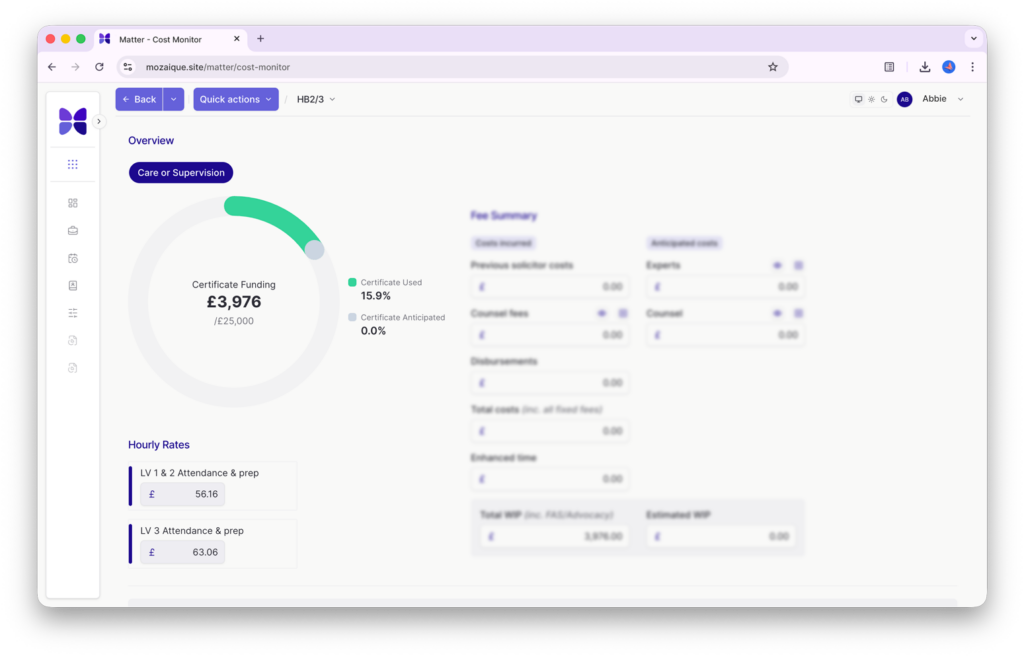
In Legal Aid Manager, the Cost Monitor sits inside every matter from the moment it is opened, providing the kind of real‑time visibility that legal aid software should deliver as standard. It shows the certificate or fixed fee value, the amount recorded so far, and how much headroom remains. All in one place, without running reports or checking spreadsheets.
As time is recorded, the indicator shifts automatically. Fee earners see the movement immediately, and supervisors can recognise when a matter is approaching its limit without needing to interrogate the file. This is continuous visibility, embedded directly into the workflow.
Why Cost Monitoring Matters in Legal Aid Practice
Legal Aid firms work within fixed fees, certificate limits and detailed assessment risk. Financial outcomes depend as much on process as on legal work. When visibility is delayed, decisions are made without understanding their financial impact.
Traditional tracking, periodic reviews, manual calculations, and spreadsheet checks create a gap between the work being done and the funding that supports it. The Cost Monitor closes that gap by keeping the financial position visible at the point decisions are made. This is one of the core functions legal aid software must support if firms are to maintain financial control.
Silent Overruns: What They Look Like in Practice
A silent overrun is the gradual movement of recorded time beyond authorised limits, without anyone noticing. In Legal Aid Manager, the Cost Monitor shows this movement as it develops. The indicator shifts as time increases, and the remaining headroom adjusts in real time. If a matter approaches its limit, that change is visible immediately, not at the billing stage.
For fixed fee matters, the escape threshold is shown as a separate marker. The system tracks the gap continuously, so the point at which a case becomes eligible for hourly billing is visible well before it is reached.
Where Traditional Tracking Falls Short
While most systems record time effectively, few are designed to model Legal Aid funding structures that align with the practical realities of how firms work.
When cost monitoring relies on manual intervention, visibility becomes retrospective, a common issue in any legal aid case management system that separates financial data from the matter workflow. The Cost Monitor removes that dependency. It automatically aligns recorded time with certificate values, fixed fees, and escape thresholds, updating as the matter progresses. There is no need to calculate positions independently or maintain parallel tools. The system does the alignment for you.

How the Cost Monitor Works Inside the Matter
When a matter is opened in your legal aid management system, the Cost Monitor provides a comprehensive view of the financial landscape by consolidating the certificate or fixed fee value with the time recorded to date. It automatically calculates the percentage of the limit consumed and the remaining headroom, while simultaneously tracking the escape threshold for fixed fee matters.
As time is added, the indicator moves. When thresholds are approached, the shift is visible. Certificated matters appear in grey, making them instantly recognisable without opening the file. Because the Cost Monitor is part of the matter itself, the information is always current. There is no refresh button. No report to run. No manual reconciliation.
Seeing the Escape Gap Before It Closes
In fixed fee matters, the escape gap is one of the most important financial turning points. Missing it often means missing the opportunity for detailed assessment.
The Cost Monitor keeps the escape gap visible throughout the life of the matter. The system continuously aligns recorded time to the threshold, so the position is always clear. Fee earners can see when the matter is approaching the point where strategy may need to change.
More Than a Visual Indicator
The indicator serves as the visual surface for a complex underlying model. Behind the scenes, the system actively manages certificate values and fixed fee structures while simultaneously tracking escape thresholds and authorised limits against recorded time. This ensures the visual feedback is always grounded in the specific financial architecture of the matter.
Supporting Better Financial Decisions
When financial information is visible, it shapes decision-making. Fee earners can see when a matter is approaching its limit. Supervisors can recognise when an amendment should be considered. The Cost Monitor does not enforce decisions, but it provides the context required to make informed ones.
Reducing Recoupment Risk
Recoupments often occur when payments on an account exceed what is ultimately allowed; this is a risk that continuous visibility helps mitigate. By keeping recorded time and authorised funding in constant alignment, the Cost Monitor reduces the risk of avoidable discrepancies and leads to more accurate, reliable billing decisions.

Designed for Legal Aid Billing Structures
Generic time recording tools cannot model the layered funding rules that a legal aid management system must support. The Cost Monitor is built specifically for those structures, allowing financial visibility to sit alongside case management rather than outside it. This works in tandem with specialised tools, such as the enhancement assessor, to ensure every aspect of the billing process is optimised.
The reliability of cost monitoring improves significantly when contract information is structured correctly at setup. By adopting a better way to manage LAA contracts, firms ensure that their financial monitoring is built on a foundation of accurate, live data rather than static PDFs or manual entries.
Financial Control Is Part of the Workflow
In Legal Aid practice, financial control is essential to sustainability. The Cost Monitor brings that control into the core of the matter, ensuring that certificate limits, escape thresholds and recorded time remain aligned, making financial oversight part of everyday practice.
Interested?
Get started with Legal Aid Manager today. Early adopters receive 6 months of FREE Mozaique AI Credits.
What is legal aid cost monitoring software?
It is a specialised tool that tracks legal aid financials, like certificate limits, fixed fees, and escape thresholds, in real time. Unlike generic software, it’s built specifically to ensure firms don’t exceed authorised funding by mistake.
How can I prevent “silent overruns” in legal aid cases?
Use a live Cost Monitor that automatically tracks recorded time against authorised limits. This visibility lets supervisors spot cases nearing their limits early enough to apply for amendments or adjust strategy before the work becomes non-billable.
What is an escape fee threshold in legal aid billing?
The escape fee threshold is the point at which a fixed-fee matter qualifies for hourly billing. Advanced systems track this visually, showing exactly how close you are to “escaping” the fixed fee and moving to a more sustainable hourly rate.
Why is real-time financial visibility important for legal aid firms?
Legal aid margins are razor-thin. Real-time monitoring allows for proactive cash flow management and ensures every hour worked is actually compensable, rather than discovering a funding shortfall weeks after the work is done.
Can legal aid software automate certificate limit tracking?
Yes. It aligns recorded time directly with the certificate value stored in the system. As you log time, your remaining “headroom” updates automatically, removing the need for manual calculations or clunky spreadsheets.
How does cost monitoring reduce legal aid recoupment risk?
Recoupment happens when payments on account exceed final allowed costs. By keeping recorded time and authorised funding in constant alignment, you can make accurate billing decisions that prevent the LAA from clawing back funds later.
What should I look for in a legal aid case management system?
Prioritise a system that integrates financial data into the matter workflow. Look for features like automated contract uploads, visual cost indicators, and built-in support for both certificated and fixed-fee rules.
How do I manage certificate amendments more efficiently?
The trick is seeing them coming. Good software alerts you when a matter hits a specific threshold (like 80% of its limit), giving your team time to submit amendment requests to the LAA before work has to stop.
Does legal aid software support both fixed fee and hourly billing?
The best systems handle the “hybrid” nature of legal aid seamlessly. They track fixed fee progress while simultaneously monitoring the escape threshold, giving you a clear view of when a case transitions to hourly rates.
How can law firms improve cash flow with cost monitoring?
By eliminating unbilled WIP and unauthorised overruns. Staying within limits and hitting escape thresholds intentionally ensures you bill the maximum amount possible without the delays caused by retrospective fixes.