Legal Aid Manager (LAM)
6 min read

What is the Mozaique Legal Aid Manager?

Overview

What is Legal Aid Manager?

Legal Aid Manager (LAM) is a SaaS case management and billing platform designed to seamlessly integrate with other systems or use as a stand-alone application. It streamlines operations, automates compliance-heavy workflows, and ensures every billable activity is captured, validated, and submitted accurately.

Legal Aid work comes with a unique set of pressures. The rules are strict, the margins are tight, and the consequences of getting something wrong often appear much later, when it is hardest to fix. Many firms only discover problems at the point of billing, long after the decisions that caused them were made. Mozaique’s Legal Aid Manager exists to help address that reality.

Legal Aid Manager removes profit-making barriers

Key features include: 
• Visual cost monitor
• AI Enhancement Assessment
• Automatic legal aid contract upload
• Seamless case management
• Billing tracker
• Time recording
• FAS (Family Advocacy Scheme)

By rethinking matter setup, time recording, funding management, and collaboration, we’ve built a legal aid system that removes profit-making barriers. At its heart, Legal Aid Manager is designed to support firms working within Legal Aid rules from the very beginning of a matter. Instead of treating eligibility, limits and compliance as checks to deal with at the end, it is built around the idea that these constraints shape the work throughout the case.

Many systems aren’t designed for Legal Aid

Legal Aid is often described as private practice with lower fees, but that comparison misses the point. Legal Aid operates under a different structure altogether. Eligibility rules, cost limits and scope restrictions influence decisions from the outset. They affect whether work can be undertaken, how far it can progress, and where risk begins to appear.

Legal Aid Manager is built for Legal Aid firms

Many practice systems were not designed with this in mind. As a result, firms often rely on experience, memory and manual checks to stay compliant. Knowledge sits with individuals rather than being supported by the system itself. When something is missed, it’s rarely obvious straight away. The impact is often felt much later, when options are limited. This creates ongoing uncertainty for fee earners and managers alike.
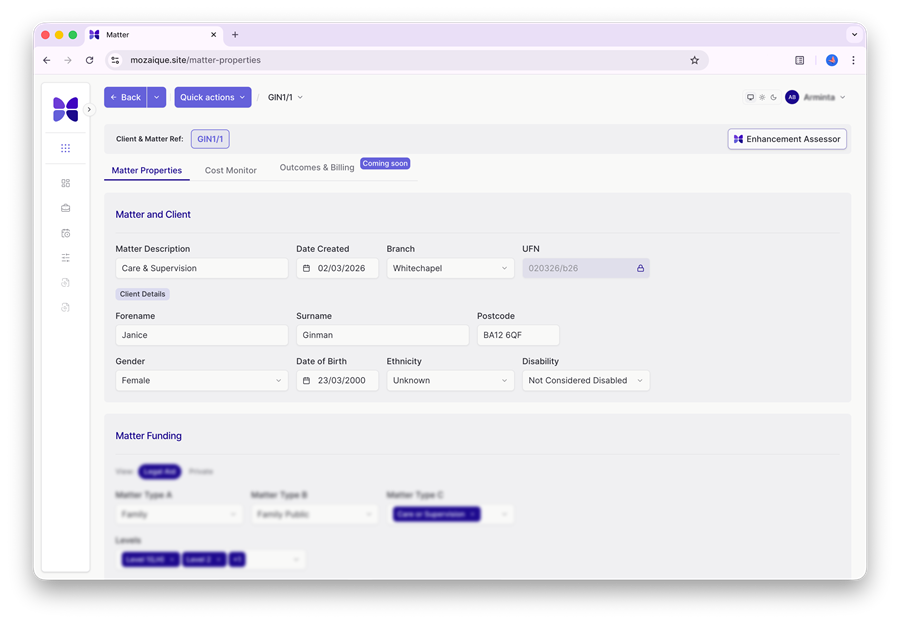
A snippet of how our Legal Aid Manager looks

Mozaique’s Legal Aid Manager is built with Legal Aid as a first-class practice area, not as an add-on to private practice workflows. Its purpose is not to automate legal judgment or promise guaranteed outcomes. Instead, it is designed to help firms see the boundaries they are working within earlier, so decisions can be made with clearer information and less stress.

When limits and requirements are clearer during the life of a matter, firms are less likely to face unexpected issues at the billing stage. Conversations about progress and viability happen sooner, rather than too late.

LAM supports your Legal Aid expertise

Legal Aid work often depends on a small number of experienced people who understand the system inside out. That expertise is invaluable, but it can also create pressure. When knowledge lives with individuals rather than being supported by systems, risk increases if workloads rise or staff change.

Legal Aid Manager is designed to support that expertise, not replace it. By embedding Legal Aid logic into the way matters are handled, it helps distribute understanding more evenly across teams. Fee earners gain confidence, managers gain earlier visibility, and firms rely less on last-minute fixes.

LAM is not a bolt-on or a shortcut. It doesn’t remove the need for professional judgement, and it doesn’t guarantee payment outcomes. Legal Aid will always involve uncertainty. The aim of Legal Aid Manager is not to eliminate that uncertainty, but to reduce avoidable surprises by making constraints clearer earlier in the process.

LAM puts Legal Aid first

Building a Legal Aid-first system reflects a deliberate choice. It recognises that Legal Aid is a core practice area with its own demands and pressures. By designing systems around those realities, rather than adapting generic tools after the fact, firms can work with greater confidence and less reactive stress.

Mozaique Legal Aid Manager exists because Legal Aid work deserves systems that reflect how it actually operates. By bringing visibility to rules and limits earlier in a matter, it helps firms make better-informed decisions, reduce late-stage disruption, and support the people doing demanding work every day.

Interested?

FAQs

What is Legal Aid Manager?

It is a system designed specifically to support law firms undertaking Legal Aid work, built around Legal Aid rules and constraints rather than private practice assumptions.

Why does Legal Aid need its own manager?

Because Legal Aid rules and limits influence decisions throughout a case, not just at the billing stage.

Does Legal Aid Manager replace legal judgment?

No. It is designed to support lawyers by clarifying constraints, not to replace professional decision-making.

Is this a bolt-on to an existing system?

No. Legal Aid Manager is designed with Legal Aid as a first-class practice area, not as an add-on.

Will it guarantee Legal Aid claims are paid?

No system can guarantee outcomes. The aim is to reduce uncertainty and late surprises, not to promise results.

How does this help fee earners day to day?

By providing clearer visibility of limits and requirements earlier, fee earners can work with greater confidence.

Does it reduce reliance on specialist billing knowledge?

It supports broader understanding across teams, while still valuing specialist expertise.

Is this suitable for firms doing mixed work?

Yes. It is designed for firms where Legal Aid is a core part of their practice.

Will this add more administration?

The intention is to reduce late-stage correction and manual checking, not to add extra admin.

What is the main benefit of a Legal Aid-first approach?

Greater clarity earlier in a matter, supporting better decisions and fewer avoidable disruptions later on.


case studies

Hear from some of our clients who love Mozaique.

Legal Aid Manager (LAM)
9 min read

Breaking the mould of Legal Tech

Overview

Product discovery insights from Accesspoint Legal

Market insights

Legal Tech challenges of 2025 are vastly different from those that shaped the development of much of today’s software. Despite this, law firms seeking to upgrade their technology often default to like-for-like replacements, swapping one Practice Management System (PMS) for another. However, the modern tech stack is evolving into a collection of best-in-breed applications, each designed to solve specific problems with outstanding efficiency.   

Amongst all Legal Tech applications, time recording, cost management, and billing are the most critical to a law firm’s profitability. However, for many SME law firms, these operations have not evolved as quickly as other areas, such as client onboarding. The urgency bias of recent years, driven by the pandemic and the deep integration of billing systems within legacy PMS platforms has contributed to this lag.

Product insights

Legal Aid lawyers operate under intense financial pressure, they manage the highest cost and billing overheads in legal services yet receive the lowest fee income. A Law Society survey revealed that 50% of the cost to run a Legal Aid case are unrecoverable, exposing a systemic challenge. Accesspoint are building software to solve that challenge. Throughout our discovery phase we examined the root causes behind inefficiencies, identifying gaps in matter setup, time recording, funding management, and collaboration that prevent lawyers from being paid what a case is worth.

Our findings reinforce an urgent need for specialised matter cost management, time capture and billing tools. It is an unknown path for an SME law firm to navigate, this article explores our key learnings and lays out a blueprint for next-generation Legal Aid SaaS solutions.

Key Learnings from Product Discovery

We started our exploration with costs written off, either known and captured through accounts or offline at billing and asked ourselves why? All paths led us back to the start of the matter, where most billing errors originate. At thematter set up stage fee earners inadvertently miss the opportunity to consider enhancements or apply incorrect funding arrangements. When the case progresses, amendments are not made. Mistakes in setting up the correct tracking led to underbilling, often without lawyers realising it until a Cost draftsperson highlights what could have been!

Current Problem

Matter setup in PMS relies on extensive manual knowledge of complex fee structures, rates, and Legal Aid Agency (LAA) rules. Even with conditional logic and automation in PMS, incorrect configurations at the outset lead to compounding financial losses. When observing incorrect matter set up, fee earners questioned replied “I knew it was wrong, but not how to put it right”!

Solution

A guided matter journey that ensures fee earners assign the right funding structure, cost categories, and recoverable fees from the beginning. Intuitive user experiences identifying clear optionality with validations anticipating and correcting common errors, while coaching lawyers to consider guidance that could justify enhancements of up to 100% right from the start.

We learned that time recording remains a universal pain point for Legal Aid and private funded B2C/B2B transactions alike. Whilst time recording apps are used widely, they fail to enhance usability so that lawyers still struggle to record time correctly and contemporaneously. Without accurate time, fixed fees and WIP are incorrect and attempts at manage costs ineffective, leaving WIP to be calculated with manual manipulation and adjustment at the billing stage.

Current Problem

Lawyers risk losing recoverable time because time recording tools don’t prevent misallocation. Many systems treat time capture as a passive data entry task rather than an intelligent billing assistant.

Increasing cost limits at the billing stage to account for missed time is nearly always impossible. If time is mis-recorded, whether under the wrong scope, matter, or omitted entirely, it is typically written off. And if a claim is submitted incorrectly, the process of recovering and resubmitting those costs can be both time-consuming and complex.

Solution

Smart time capture tools that:

  • Provide real-time validation against LAA rates and fees
  • Differentiate the different scope and levels of a matter to prevent mis-posting
  • Enable time to be deleted, re-allocated or moved where necessary
  • Offer simple, intuitive interfaces significantly reducing errors

Legal Aid cost control and billing is notoriously complex, spanning different contract types (criminal, civil, family), each with its own funding rules. One matter can have multiple levels and fixed fees running concurrently. Many existing software solutions passively accept data input without validating if it aligns with funding criteria.

Current Problem

Lawyers struggle to manage matter costs effectively because they often lack clear visibility into what a case is worth, both at each individual funding level and in aggregate across scopes and limits. This lack of insight leads to lost revenue, as firms fail to anticipate the need for cost limit or scope extensions before incurring costs.

Solution

Matter cost monitor: A simple source of truth for consolidated matter costs that:

  • Manages costs against budget with both WIP and anticipated costs budgeted
  • Associates the correct funding scheme based on matter type
  • Displays all funding and WIP in an intuitive dashboard with calls to action
  • Alerts lawyers when funding thresholds are likely to be reached, enabling them to submit proactive applications for cost increases, creating tasks and tracking completion

Cost budgeting and billing requires input not just from individual lawyers but also from finance teams, external counsel, and lawyers. Without dedicated collaboration tools, billing communications happen via email chains, spreadsheets, annotated reports and disconnected databases, increasing the risk of lost or duplicated information.

Current Problem

Key stakeholders (fee earners, accounts teams, internal and external billers) lack a shared space to collaborate on case billing. This leads to ineffective communication, billing delays, billing insight gaps and inaccurate or disputed claims.

Solution
  • A centralised billing workspace where all stakeholders can review costs, leave notes, share tasks and flag issues in real time
  • A billing tracker that tracks WIP all the way through the billing process, from draft to payment for all claims across all departments.
  • Insight updates identifying trends in good and bad practice, WIP lock up and benchmarks for internal stakeholders comparable to the market.
  • Integration with existing PMS to ensure seamless transition between casework and billing

Conclusion: breaking the mould to innovate

The discovery phase reinforced a clear reality: Legal Aid lawyers are systematically underpaid due to outdated technology and inefficient processes. The current Tech landscape often forces practitioners to fit their workflows into generic PMS tools, instead of providing purpose-built solutions that align with Legal Aid’s unique complexity.

By rethinking matter setup, time recording, funding management, and collaboration, we are designing a system that removes barriers to making a profit. This isn’t just about improving billing, it’s about providing Legal Aid practices with a route to financial sustainability. As we move forward, we stay committed to one goal:

Delivering precise, intelligent software that enables lawyers to do the work, get paid and build a practice where Legal Aid has a future.

Whether you want to be first in line to benefit from our Legal Aid Module, or need some advice on how to formulate your plans for a best in bread tech stack, contact us for advice, support or just a catch up!

case studies

Hear from some of our clients who love Mozaique.

Legal Aid Manager (LAM)
3 min read

When innovation meets access to justice

Overview

We’re giving Legal Aid lawyers their time back

Did you know?

In 2024, 82% of practitioners surveyed by the Law Society reported that Legal Aid work was loss-making. The challenge wasn’t skill or dedication; it was that the digital tools built for private-practice billing didn’t fit the complex, rule-bound world of Legal Aid. We saw an entire sector working in fragments: spreadsheets here, portals there, disconnected systems everywhere.

So we set ourselves a simple but audacious goal: make Legal Aid viable again through intelligent automation and guided design.

Listening before building: we started with research, not code.

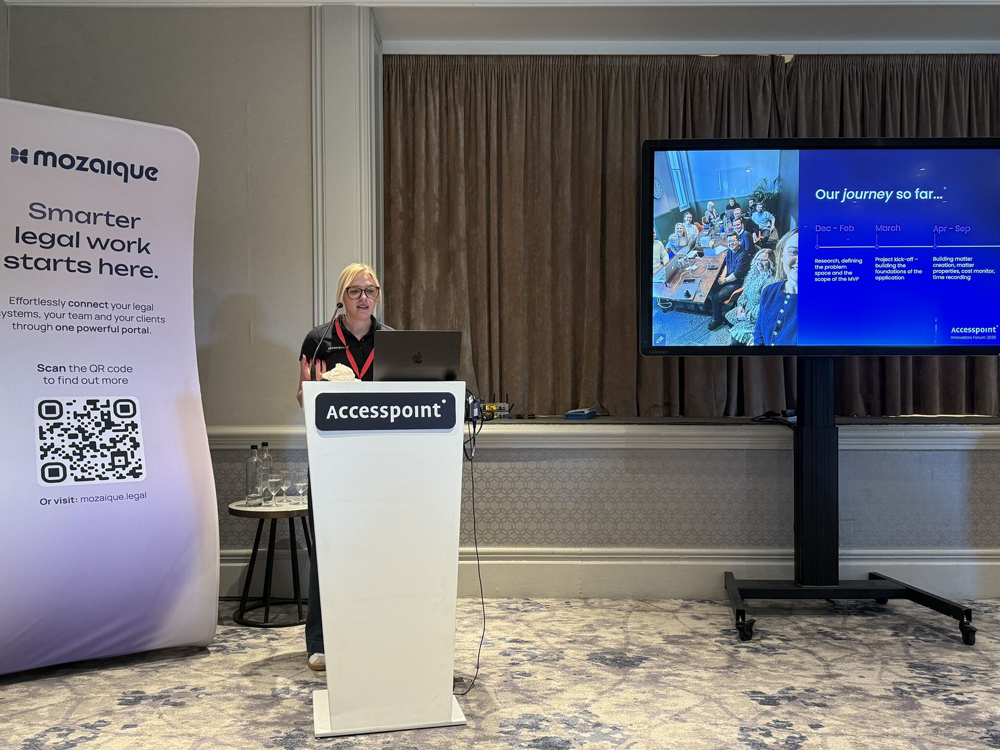
We interviewed lawyers, cost drafters, cashiers, rep bodies, and Legal Aid Agency contacts. We hosted workshops with partners, ops leads, and IT teams to map every breakdown trigger from client onboarding to final billing. Those sessions revealed the heart of the problem: lawyers weren’t short of data, they were short of time and tools that understood Legal Aid logic.

Our brief became clear: turn expertise into an experience, not just another administrative task.

Designing a guided journey

From that insight came the Legal Aid Manager (LAM), a standalone SaaS platform that helps firms manage budgeting, cost control, time capture, and compliance in one connected workflow. It doesn’t just record numbers; it thinks alongside the lawyer, prompting the right actions at the right time. LAM front-loads prediction — anticipating enhancements, funding limits, and fee changes — so firms recover more of what they earn and reduce WIP lock-up.

Built with empathy and precision

Behind the interface lies months of structured R&D.

  • AI agents that learn from paid bills to suggest future enhancements.
  • Middleware that bridges legacy PCMS systems and modern cloud tools.
  • Conditional logic trees that model how real Legal Aid cases evolve day to day.
    Each feature originated from collaboration: engineers working closely with lawyers, reimagining what “cost management” could mean when it’s simple, visual, and intuitive.

A community approach to innovation

Eight pilot firms representing every type of PCMS helped test each sprint. Their feedback shaped the product as much as the code did. That partnership model is now a core Accesspoint principle: every build is a shared build.

The Legal Aid Manager isn’t about replacing people. It’s about giving Legal Aid lawyers their time back. By letting the software handle the complexity, lawyers can again focus on the reason they joined the profession in the first place: helping clients find justice.

case studies

Hear from some of our clients who love Mozaique.

Book a demo

This field is for validation purposes and should be left unchanged.